

Olympic Medalist Kennedy Blades Aims for Historic Title in Inaugural NCAA Women’s Wrestling Championship

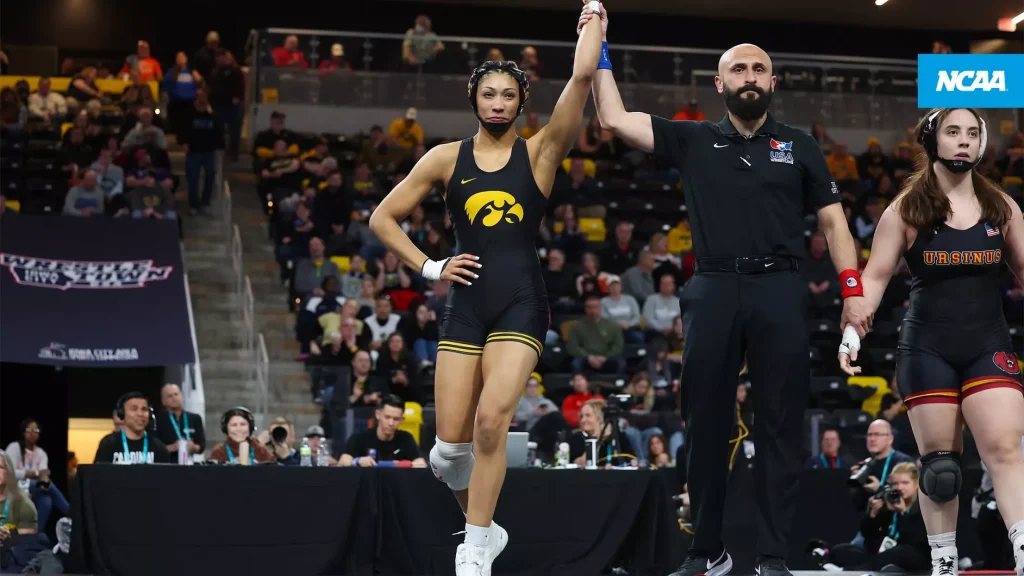
The University of Iowa’s Kennedy Blades, the reigning Women’s College Wrestler of the Year and an Olympic medalist, enters her senior season focused on achieving a new milestone: winning the inaugural NCAA Women’s Wrestling Championship. After a pivotal experience at the 2024 Paris Olympic Games shaped her approach to public persona, Blades continues to dominate her sport while prioritizing positive fan interaction and role modeling for the next generation.
The 2024 Paris Olympic Games served as a turning point in how Blades views her growing stardom. Before the opening ceremony, the then unranked wrestler sought out her favorite athletes for pictures and autographs. She recalls being deeply hurt when one idol turned her away with a blunt “no pictures.”
“I was sad because I really looked up to this person, and it hurt me so bad. So, yeah, I went back to my room and cried a lot,” she said.
Drying her tears, Blades made a profound promise to herself. “That feeling I had, I just would never wish it upon anyone else,” she vowed. “So every single time anyone comes up to me asking for an autograph or a picture, I always do it.”
This commitment to giving back is evident in her actions; Blades consistently takes time to meet with every single fan who approaches her, even when lines stretch up to 100 people deep after her matches.
Blades went on to win a silver medal in Paris, an accomplishment that cemented her status as a leading figure in women’s wrestling. Following the Games, she completed an undefeated junior year at Iowa, securing a national collegiate title and earning the USA Wrestling Women’s College Wrestler of the Year award. Her success now draws lines of up to 100 people waiting for autographs after every competition.
Blades’ athletic journey began early, born out of a parental attempt to channel the fighting spirit of young Kennedy, 4, and her sister Korina, 3. Their parents, Saul Pulido and Cindy Ramos, initially taught the girls boxing, which resulted in black eyes and concerned calls from their day care provider.
“We weren’t the greatest kids,” Kennedy shared. “We would get into trouble, so my parents needed to figure out how to basically get our energy out because we were so hyper. They thought a combat sport would be perfect.”
The girls were enrolled in Brazilian jiu-jitsu, a mixed martial arts discipline, with Saul running the girls through daily drills. Within a year, Kennedy and Korina were winning national tournaments, often competing against boys because few girls participated in combative sports at age 5.
When Kennedy was 7, her parents guided her toward wrestling, seeing the potential for college scholarships and Olympic opportunities. Within the first week, Kennedy had found her sport. Her parents became the backbone of her career: Cindy worked overtime to fund tournament and travel fees, while Saul handled the hourlong drives to practice and ran two extra hours of drills when they returned home. “As much of an individual sport as wrestling is, it really takes a team to accomplish a lot of success, especially success that I’ve had. The backbone really is my family,” Blades reflected.
In high school, Blades committed to college wrestling, initially choosing Arizona State. She was adamant about pursuing education, stating, “My parents always said your career could end any time, so you still need a backup plan for education.” At Arizona State, she balanced her college season training with her Olympic pursuit, ultimately earning a bid to the 2024 Paris Games and reaching the final match in the 76 kilogram freestyle.
“I took silver, which I wish I got gold, but I’m very happy I still brought a medal,” she said.
Upon returning from the Olympics, the club at Arizona State shut down, prompting Blades to seek a transfer. She chose the University of Iowa, drawn by its rigorous atmosphere and elite coaching staff, which includes Olympic bronze medalist Coach Clarissa Chun, three time Olympic medalist Coach Tonya Verbeek, and Coach Gary Mayabb, who has worked with multiple senior world athletes. “I was like, ‘OK, is this the place I want to be?’ And my answer, before I even finished my question, was ‘yes,'” Blades recalled.
The decision solidified her spot as the top women’s collegiate wrestler and a powerful role model. For Blades, the message is clear: “Wrestling is for everyone, no matter the age, no matter the race, no matter the gender.”
Recently, a long awaited goal was added to her list: “Then the best news ever, which is the NCAA is to make women’s wrestling the 91st sport for NCAA Championships,” a milestone she did not think would be accomplished during her college eligibility. “So when that was announced, I was like, ‘Oh my gosh, we can win the iconic trophy one day.'”
Coach Chun shares the excitement for the championship, which will take place in Coralville, Iowa, in March. “Every one of our women want the opportunity to compete on the biggest stage and have the notoriety of the ability to be considered an NCAA champion,” Chun said. Blades’ continued pursuit of the NCAA title, despite her international success, highlights the significance of the collegiate stage. “She still wants to have that NCAA national champion title behind her,” Chun noted.
Last season, Blades won the 160 pound title in the National Collegiate Women’s Wrestling Championship, an event organized by the Women’s Collegiate Wrestling Coalition, which the new NCAA championship will replace. For Blades, competing in an NCAA sanctioned championship symbolizes the rapid growth of the sport.
“When I was a girl, there were only guys to compete against. There was no choice. It’s either you wrestle against guys or forget the sport. So seeing how far it came and how many sanctioned states there are for women’s wrestling is mind blowing,” Blades said. “I’m just so happy to be a part of it.”
Blades is not just a participant; she is a leader, creating a fast paced, aggressive style, defined by throws and double leg takedowns, that others seek to emulate. Chun is proud of the visibility Blades brings. “It’s bigger than any one of us. She’s doing it for the growth of women’s wrestling, being who she is. I love that she has a lot of eyes on her, a lot of visibility because she’s earned it.”
As a business and marketing major, Blades ensures her discipline extends beyond the mat, prioritizing turning in class assignments on time, studying daily, and consistently getting eight hours of sleep. “I carry the sport in my lifestyle,” she said.
Her commitment to intentional fan interaction remains unwavering, driven by the vow she made at the Olympics. “I don’t want them to feel the way I did. Even though sometimes it does get overwhelming, I’m still like, ‘No, I want to do this for them ’cause they’re amazing people and they’re my fans. They’re people that help me become a better person, so let me give back to them, too.'” Blades now has her sights set on two gold medals: the 2028 Los Angeles Olympics and the historic NCAA championship trophy.