

The Business of the Star Quarterback: DJ Lagway’s NIL Game is a Big Winner

Winning in sports requires more than just physical talent. At the highest levels of competition, the difference between good and great often comes down to one thing: mental conditioning. The ability to push through challenges, maintain focus under pressure, and stay resilient in the face of setbacks is what separates elite athletes from the rest. What’s remarkable is how these same psychological traits—the mindset of a champion—can be translated into the professional world. The psychology of winning, forged in athletic competition, is a powerful tool that can lead to career success in any field.
One of the most critical aspects of mental conditioning is developing a growth mindset. In sports, athletes are taught to embrace challenges, view mistakes as learning opportunities, and believe in the power of effort. The fixed mindset—believing that ability is static and can’t be changed—limits growth, while the growth mindset allows individuals to see their potential as expandable through hard work and perseverance. When transitioning into a career, this mindset is invaluable. A professional who approaches challenges with the belief that they can improve with effort is far more likely to succeed than one who feels stuck by limitations.
For example, consider an athlete who is used to training for long hours to master a new skill. In the professional world, this translates to tackling unfamiliar projects, learning new software, or adapting to changes in the industry. The same drive that pushes an athlete to improve their performance also pushes a professional to seek growth in their career. Setbacks, whether they come in the form of lost clients or failed pitches, are seen not as failures but as opportunities for improvement—just like a tough loss on the field is viewed as motivation to train harder for the next game.
Mental toughness, another key component of the psychology of winning, plays a huge role in both sports and career success. Athletes are constantly challenged to perform under immense pressure, whether it’s hitting the game-winning shot or staying calm during a penalty kick. In business and other professional environments, the ability to remain composed and clear-headed during high-stakes situations is crucial. Whether it’s delivering a major presentation, closing a big deal, or navigating a crisis, those who possess mental toughness are able to thrive under pressure.
This trait is developed through years of practice in the athletic arena. Athletes learn how to block out distractions, silence self-doubt, and focus on the task at hand. The same focus applies in the workplace, where distractions and stressors abound. A professional with mental toughness doesn’t crumble under tight deadlines or demanding clients. Instead, they channel the pressure into performance, much like an athlete who uses the energy of a big crowd to fuel their game.
In addition to resilience and focus, visualization is another technique that athletes use to prepare for success. In sports, visualization is the process of mentally rehearsing a game, a race, or a match in vivid detail. Athletes picture themselves performing at their best, going through the motions, and executing their skills flawlessly. This technique primes the brain for success by reinforcing positive outcomes. In the professional world, visualization can be just as powerful. Before a big meeting or presentation, professionals can visualize the event unfolding smoothly, anticipating potential challenges and mentally rehearsing how they’ll navigate them.
This mental rehearsal can build confidence and reduce anxiety, allowing individuals to enter high-pressure situations with a sense of calm and control. The same confidence that comes from seeing yourself win a match can come from seeing yourself nail a presentation. By visualizing success, individuals program their minds to perform at their best when it matters most.
Moreover, athletes are trained to set specific, measurable goals, a practice that translates seamlessly into the professional world. Goal-setting is at the core of athletic training—athletes set targets for improving their performance, whether it’s shaving seconds off a sprint or increasing their strength in the gym. These goals are broken down into actionable steps, and progress is tracked meticulously. This process is equally effective in the workplace, where professionals set career goals, sales targets, or project deadlines. Just as athletes adjust their training to meet new challenges, professionals must adapt their strategies to reach their goals.
Perhaps one of the most important aspects of the psychology of winning is the ability to stay resilient in the face of failure. In sports, failure is a given. No athlete wins every game or sets a personal record every time they compete. But athletes learn how to bounce back, using failure as fuel for their next success. This same resilience is key to career success. The professional world is full of setbacks—rejected proposals, missed promotions, or unforeseen obstacles. Those who succeed are the ones who, like athletes, keep pushing forward, learning from their failures and using them as stepping stones to future achievements.
Resilience is about more than just enduring tough times; it’s about adapting, growing, and ultimately thriving because of the challenges faced. Athletes learn to embrace discomfort and uncertainty, knowing that pushing through hard moments is what leads to success. In a career, resilience is what allows individuals to keep going when the path is unclear, to stay motivated when progress is slow, and to continue striving for excellence even in the face of adversity.
The psychology of winning, with its emphasis on growth, mental toughness, focus, visualization, goal-setting, and resilience, is not just about achieving success in sports—it’s about succeeding in life. These traits, honed through years of competition, give former athletes an edge in the professional world. The mental conditioning that leads to victory on the field is the same conditioning that can lead to triumph in a career. Athletes are well-equipped to tackle the challenges of the workplace, and their mindset can be the key to unlocking long-term success.
He played well enough in his first season to earn Freshman All-American honors, rejuvenated the Gators and their hungry fan base by winning six of his seven starts, and enters his sophomore season as one of college football’s marquee players.
No disrespect to 7-foot-9 Gators center and O’Dome favorite Olivier Rioux – a marketing standout on the rise in his own right – but UF sophomore quarterback DJ Lagway is currently the undisputed big man on campus.
“He is QB1 at a top-five brand in college football,” said Ben Chase, Florida’s director of name, image and likeness (NIL) strategy. “When you come to play at a place like Florida, and you attach your brand to the Gators’ brand, this is what happens in the NIL era.”
Lagway, much to the relief of Florida fans, is back on the field after an offseason hampered by injuries. He made his first career start in a season opener last Saturday night when the Gators beat Long Island, 55-0.
While much of the football-centric news over the past eight months centered on Lagway’s aches and pains, the 20-year-old Lagway’s business profile has thrived, much like Apple stock in the late 1990s, when Steve Jobs returned to the company. Lagway’s latest deal was announced on Friday, when Jordan Brand revealed an NIL partnership with Lagway, who joins a select roster of handpicked talent, including NFL quarterbacks Jalen Hurts and Bryce Young, on Jumpman’s roster of football players.
The Jordan Brand deal is just one of a string of Lagway endorsements that have made him a national figure – 192 passes into his college career. Lagway’s agreements stretch far and wide.
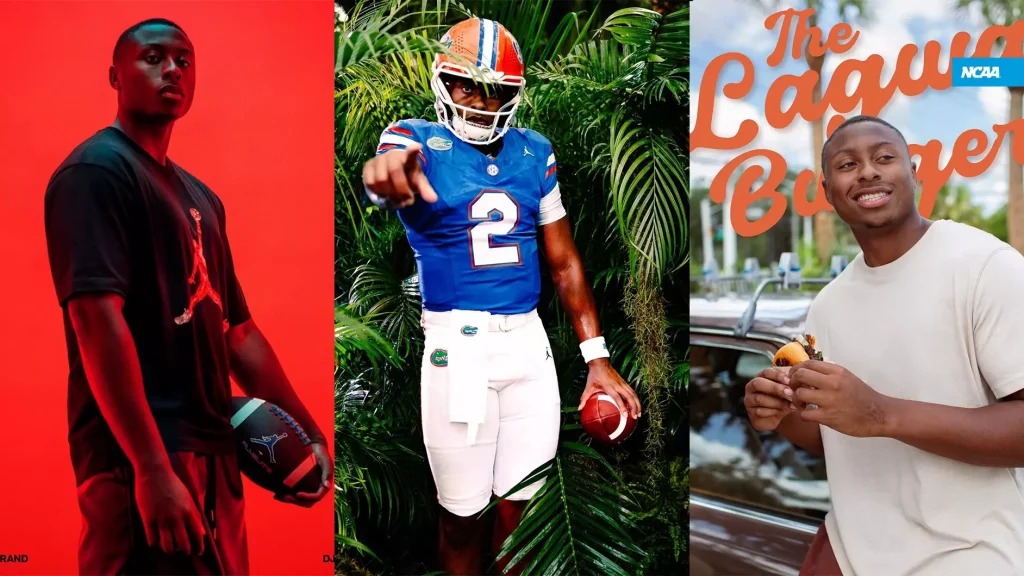
On the national level, Lagway has partnered with headphone company Beats by Dre, shot a T-Mobile commercial with Patrick Mahomes and Rob Gronkowski, signed an NIL deal with Gatorade, and appeared on the cover of the EA Sports College Football 26 Deluxe Edition video game.
Lagway also has a strong local portfolio.
DJ’s Cast Iron Burgers, a food truck located off West Newberry Road in Gainesville, features The Lagway Burger. Lagway has a NIL deal with Lamborghini Orlando and an equity partnership with NIL Launchpoint, a mobile and web platform designed to connect college athletes with brands for NIL deals.
Lagway has also demonstrated a philanthropic spirit, partnering with UF Health for a $50,000 donation through the DJ Lagway Foundation. In March, he reportedly donated $100,000 to Florida Victorious to support the NIL efforts of the UF women’s athletic programs.
“Football has given me so much, and NIL has opened doors I could never have imagined,” Lagway said when his foundation announced the UF Health partnership. “Now, I want to use those opportunities to pay it forward.”
Napier discussed the potential of such opportunities with Lagway and his family long before the Texas native made his collegiate debut in last season’s opener against Miami. Napier understood the changing landscape of college athletics in the NIL era and, as of July 1, the revenue-share era.
Lagway, the No. 1-rated dual-threat quarterback in the nation coming out of Willis (Texas) High, was going to have opportunities at UF that might not exist at places without such national recognition.
“You see NFL quarterbacks that are literally two and three years older than him. His level of contribution here is the same, what he does for our football team, what he does for our athletic department, and in reality, what he does for our university,” Napier said. “Sports are the front porch, right? Think about what our basketball team accomplished this past spring. There is no bigger spotlight on the University of Florida than your team in the Final Four, in the SEC Tournament, and winning the national championship, and not only doing it on the court, but the way they did it and the type of team they had.
“DJ is no different. I think he’s representing the university in a first-class manner, the way he has given back. He’s not showing up with an attitude of ‘I’m here to be served,’ he’s showing up with an attitude of ‘I’m here to serve.’ He’s using his platform and being a good example for others in the future.”
As Lagway’s personal brand has grown, so have expectations. He has become more ubiquitous in the psyche of Gator Nation than any player since Tim Tebow.
So much of the buzz surrounding Saturday night’s opener revolves around Lagway’s presence and what that could mean for a program that opens the season ranked No. 15 in the AP Top 25, marking the first time since 2021 that Florida has started a season ranked.
The man ultimately responsible for Lagway being at Florida is confident in his star prospect.
“He made a name for himself last year with the way he competed as a freshman,” Napier said. “You saw the talent; you saw the ability was there. Now is the fun part. He knows what it’s like. We’ve built the team around him.
“The most important thing here is that he has consistently been consumed by improvement. This is a guy, regardless of his status, whether he’s been successful or struggled at times, he has shown up with an attitude of ‘I want to get better.’ He wants to be at his best for his team.”
Those who spend the most time around Lagway – his teammates – say that whatever star power he owns outside the Heavener Football Training Center is turned off inside the building. Lagway strives to be one of the guys, a young player who is willing to work to fulfill all that untapped promise in his 6-foot-3, 247-pound frame.
Running back Ja’Kobi Jackson’s journey is apples to oranges when compared to Lagway’s. He missed out on opportunities after graduating from high school due to the COVID-19 pandemic, eventually spending parts of three seasons at a junior college in Mississippi.
Jackson sits across from Lagway in Florida’s locker room and applauds how Lagway has responded to his high-profile position.
“He has handled it very well,” Jackson said. “You wouldn’t notice that he has been on all those commercials. He’s the same way every day when I talk to him. He is a really cool guy.”
That is what Napier wants to hear – not that he ever had any doubts.
“He’s built for it,” Napier said. “The key is that he has the levelheadedness to not let it change who he is, his perspective, his non-negotiables on life. I think that’s where he is a little bit different. He wants to be his best, and then he wants to be the best, and he’s willing to work for that.”
He has also worked on fitting in away from the football team.
Lagway struck up a relationship with Gators softball player Ava Brown after enrolling at UF in January 2024, welcomed to town by none other than Gators legend Emmitt Smith. The two have shared photos on social media, and Lagway is a regular at Seashole Pressly Stadium during softball season.
Chase, who works closely with UF athletes in the NIL space, said Lagway’s engagement with Gators fans and the student body has shown there is a person behind the brand.
“He cares more about what’s on the field than all these other opportunities,” Chase said. “I remember seeing him at softball in the spring. It was a doubleheader against Texas, and we lost both games. He stayed the whole time, something like six hours. That level of loyalty to the university and his girlfriend shows you who he is.”
Lagway will make his ninth career start on Saturday night. We know a great deal about him as a campus celebrity and the face of the NIL era in college athletics. There is much we don’t know about him as a player.
Napier has a good idea of what type of player Lagway can be. And like the rest of us, he is eager to see what that means on the field.
“There is even more out there for DJ to accomplish,” Napier said. “He’s just getting started.”